

How to Choose the Right Airline for Pet Travel
For discerning pet owners, choosing an airline involves far more than comparing departure times, cabin amenities, or ticket prices. When a beloved companion joins an international itinerary, the quality of the journey depends on the airline’s animal transport policies, cabin eligibility, carrier requirements, handling procedures, and ability to accommodate the pet’s individual needs. Some carriers permit small animals to travel in the passenger cabin, while others offer different arrangements or restrict animal transport on particular routes. The most suitable airline is therefore not necessarily the most prestigious one, but the carrier that combines reliable service, transparent requirements, and an appropriate travel arrangement for the animal.
Which Airline Policies Matter Most When Traveling With a Pet?
The most important airline policies are those governing cabin eligibility, carrier dimensions, animal restrictions, route availability, and the conditions under which a pet may be transported.
Airlines establish their own requirements within the framework of applicable aviation and animal-transport regulations. These rules can differ substantially between carriers, aircraft, destinations, and even individual flights operated by the same airline. A pet accepted in the cabin on one route may not be permitted on another, particularly when international restrictions or aircraft limitations apply.
Before selecting a ticket, investigate the following essential policies:
- Cabin eligibility: Confirm which species and sizes are accepted in the passenger cabin, whether weight limits apply to the animal and carrier together, and whether the pet must remain inside the carrier throughout the flight.
- Carrier specifications: Check the permitted dimensions, ventilation requirements, closure systems, and whether the carrier must fit beneath the seat in front.
- Animal restrictions: Review any limitations involving breed, age, health, or other characteristics that could affect eligibility.
- Route availability: Verify that the airline transports pets on every segment of the itinerary, including connecting flights and codeshare services.
- Advance reservations: Ask how pet spaces are allocated, whether availability is limited, and when the animal must be formally confirmed.
- Fees and documentation: Establish the total transport cost and identify the health certificates, identification records, permits, or other documents required for the journey.
The distinction between a pet-friendly reputation and a genuinely suitable policy is important. An airline may welcome small dogs and cats but offer limited cabin capacity, restrictive carrier dimensions, or no appropriate arrangement for a particular itinerary.
Always obtain confirmation that the animal is accepted on the exact flight before purchasing a non-refundable ticket. If several airlines operate the same route, compare their written policies rather than relying solely on general customer-service descriptions.
Is Cabin Travel or Cargo Transport Better for Your Pet?
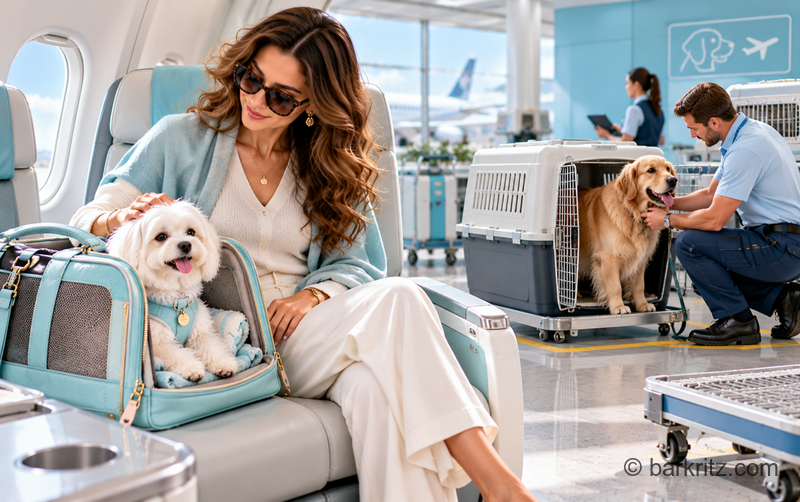
Cabin travel is often preferable for eligible small pets because the owner can remain nearby, but the safest appropriate arrangement depends on the animal’s size, health, temperament, destination, and the airline’s transport procedures.
Many airlines permit qualifying small dogs and cats to travel in an approved carrier beneath the passenger seat. This arrangement allows the owner to monitor the journey while keeping the animal in a familiar, controlled space. However, cabin travel is not available for every pet, and some animals may find the confined environment, unfamiliar sounds, and extended periods inside a carrier stressful.
Larger animals may need to travel through an airline’s designated animal-transport service, where available. Depending on the carrier and route, this may involve a specialized hold designed for animal transport or arrangements through a separate cargo service. These options are not identical, and owners should understand exactly how their pet will be handled.
The main considerations include:
- In-cabin transport: Usually suited to eligible small pets that can remain comfortably inside an approved carrier for the duration of the journey.
- Checked animal transport: Available only through participating airlines and subject to specific restrictions, handling arrangements, and route conditions.
- Manifest cargo: May be necessary for some larger animals, international itineraries, or destinations where other options are unavailable.
- Breed-specific considerations: Short-nosed dogs and cats may face additional restrictions because of their increased susceptibility to respiratory difficulties, particularly under stressful or hot conditions.
- Individual temperament: An animal that becomes severely distressed in confined spaces may require additional preparation and veterinary guidance before flying.
Do not assume that cargo transport is automatically unsafe or that cabin travel is suitable for every pet. The relevant questions concern the carrier’s actual procedures, environmental controls, handling standards, and ability to accommodate the animal safely.
For pets with respiratory conditions, cardiovascular concerns, advanced age, or a history of severe travel anxiety, consult a veterinarian before booking. Sedatives and tranquilizers should not be administered for air travel unless specifically recommended by a veterinarian who understands the circumstances, as they may introduce additional risks.
The best arrangement is the one that meets the animal’s physical and behavioral needs while complying with the airline’s requirements and the destination’s regulations.
How Can You Compare Airlines for International Pet Travel?
The best airline for international pet travel is one that can accommodate the animal on every segment while providing clear guidance on documentation, transit requirements, and destination-specific restrictions.
International journeys introduce complexities that do not arise on many domestic flights. A pet may need a microchip, vaccinations, a veterinary health certificate, an import permit, or additional documentation depending on the countries involved. Some destinations impose waiting periods, laboratory testing requirements, approved entry points, or specific rules concerning the timing and format of veterinary documents.
The airline’s policies are only one part of the process. Government authorities in the departure country, transit countries, and final destination determine the applicable animal-entry requirements. Meeting the airline’s conditions does not automatically guarantee permission to enter another country.
Compare international carriers using several practical criteria:
- Direct-flight availability: A nonstop route can reduce handling changes, waiting periods, and the possibility of missed connections.
- Transit compatibility: Confirm that pets are accepted at every connection and that the transfer arrangements comply with the rules of the transit country.
- Documentation support: Look for clear written instructions about required forms, submission deadlines, and check-in procedures.
- Destination eligibility: Verify that the airline transports pets to the intended destination and uses an entry airport permitted by local regulations.
- Seasonal restrictions: Check whether extreme temperatures or seasonal operating conditions affect animal acceptance.
- Schedule reliability: Consider connection duration, overnight stops, and the consequences of a delay or cancellation for the pet.
A direct flight is often attractive because it can simplify logistics, but it is not automatically the best choice if the aircraft, carrier dimensions, or transport arrangements are unsuitable. A longer itinerary with an appropriate transport service may be preferable to a nonstop flight that cannot accommodate the animal safely.
For international journeys, begin preparation well in advance. Veterinary examinations, laboratory tests, permits, and official certificates may need to be completed within specific time windows. Some documents must be endorsed by a government authority, and certain destinations require procedures that cannot be arranged at the last minute.
Before finalizing the booking, confirm the requirements with the relevant official animal-import authority and the airline itself. Request written confirmation for the pet’s itinerary, including every connection and any segment operated by a partner carrier.
What Questions Should You Ask an Airline Before Booking?

Before booking, ask the airline to confirm in writing that your specific pet is eligible for the intended itinerary and that the proposed carrier, documentation, and transport arrangement satisfy its requirements.
General policy pages are useful starting points, but they may not resolve every detail of an individual reservation. A conversation with the airline’s pet-travel team can help identify restrictions that would otherwise emerge only at check-in.
Prepare a concise list of questions covering the entire journey:
- Is my pet accepted on the exact flight, aircraft, and travel date?
- Can my pet travel in the cabin, or must another transport arrangement be used?
- What are the maximum carrier dimensions and combined weight limits, if applicable?
- Does the carrier need to meet particular ventilation, material, or closure requirements?
- Are there restrictions related to the animal’s breed, age, health, or physical characteristics?
- What is the total fee, and when must it be paid?
- How far in advance must the pet’s reservation be confirmed?
- What documents must be presented at check-in, and are original copies required?
- Are there any restrictions on connecting flights, codeshare segments, or transit airports?
- What procedures apply if the flight is delayed, cancelled, or diverted?
- Where and when must the animal be presented at departure, and how will it be handled on arrival?
The answers should be specific to the actual itinerary. If a representative confirms that a pet is accepted, ask whether the confirmation applies to every segment rather than only the first flight. Keep the reservation reference and any written correspondence accessible throughout the trip.
It is also worth examining the carrier’s contingency procedures. Delays, aircraft substitutions, and unexpected schedule changes can affect pet transport, particularly when an animal has been accepted under limited cabin capacity or a specialized cargo arrangement. Ask what happens if the original transport plan becomes unavailable and whether an alternative flight can accommodate the pet.
Finally, distinguish between an airline’s general animal policy and confirmation of an individual reservation. A published policy establishes what may be permitted; a confirmed booking establishes that the carrier has accepted the specific pet for the planned journey, subject to the applicable conditions.
How Can You Prepare Your Pet for a Smooth Airline Journey?

A smooth airline journey depends on choosing an appropriate carrier, preparing the animal gradually, completing all documentation on time, and organizing the itinerary around the pet’s welfare rather than convenience alone.
Preparation begins well before departure day. If the animal will travel in a carrier, introduce it at home and allow the pet to explore it voluntarily. Short, positive practice sessions can help the carrier become a familiar resting place rather than an unfamiliar enclosure encountered only at the airport.
The carrier should be secure, well ventilated, appropriately sized, and compliant with the airline’s exact specifications. The animal must be able to maintain a natural, comfortable position within the permitted space. Avoid last-minute purchases that have not been tested at home, especially if the carrier has unfamiliar closures or a different internal shape.
A practical preparation checklist includes:
- Carrier acclimation: Allow the pet to spend time inside the carrier well before departure, using familiar bedding where permitted.
- Veterinary assessment: Discuss the animal’s fitness to fly, relevant medical conditions, stress responses, and any destination-specific health requirements.
- Document verification: Check identification, vaccination records, certificates, permits, and official endorsements against the current rules for every country involved.
- Reservation confirmation: Reconfirm the pet’s acceptance and any check-in instructions with the airline before departure.
- Comfort planning: Pack familiar supplies, suitable food, water, waste bags, and any necessary medications in accordance with transport rules.
- Airport timing: Allow sufficient time for document checks and animal-specific procedures without unnecessarily prolonging the pet’s stay in a busy terminal.
- Arrival arrangements: Identify the correct collection point and plan onward transport in a suitable, secure vehicle or carrier.
On the day of travel, follow the veterinarian’s and airline’s instructions regarding feeding, hydration, toileting, and exercise. Avoid making sudden changes to the pet’s routine, and do not force an animal to wear clothing or accessories that interfere with movement, temperature regulation, or carrier fit.
For pets traveling in the cabin, confirm the rules for removing the animal from its carrier at security screening, since procedures vary by airport. For animals transported separately, establish exactly where they must be delivered and collected, and make sure contact information is current.
The most thoughtful airline choice is ultimately the one that allows the journey to be planned around the pet’s specific needs. A prestigious cabin, an attractive fare, or a convenient departure time cannot compensate for an unsuitable transport arrangement. When airline policies, veterinary guidance, documentation, and practical preparation align, traveling together becomes a more manageable and reassuring experience for both pet and owner.